
Reviewed · WARSAW GHETTO & JEWISH HERITAGE
Jewish Warsaw Walking Tour
Jewish Warsaw has a gravity that is hard to get any other way. This walking tour strings together the places that survived the destruction of the Warsaw ghetto, then points you toward the memorial spaces where the story is meant to land. You get a guided route with free entry at each stop, so you are not scrambling for tickets while you are trying to understand what you are seeing.
I especially like the way the guide connects the dots between landmarks that are now scattered and what those spaces meant back then. You also tend to get a human touch, with guides like Olivia and Jacek described as passionate, accurate, and even funny in a dry way, which helps when the material turns very heavy. One consideration: it is a lot of standing and walking for about 2 hours 30 minutes, and on a cold, windy day you may feel it, even if the guide sometimes finds a chance to sit near the end.
Here is what makes this tour worth your time, and how to decide if it fits your style.
Key Highlights You Should Plan Around
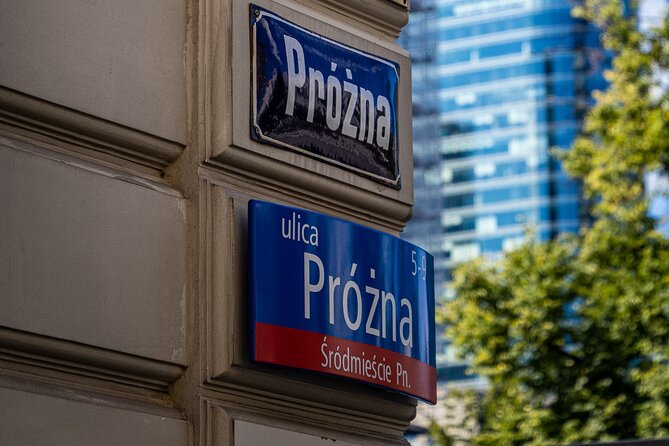
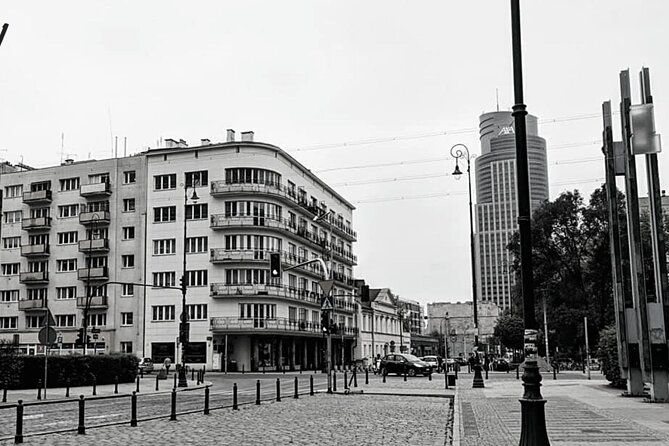
- Surviving ghetto-era locations like Grzybowski Square, where little physical evidence remains, but the area still matters.
- Nożyk Synagogue as the lone pre-war survivor, a rare chance to see something that predates the catastrophe.
- A clear tracing of the ghetto border, with Waliców and the Chłodna Street footbridge memorial keeping the geography in mind.
- POLIN Museum stop timed for impact, including the 1948 Monument to the Ghetto Heroes.
- Memorial pacing that changes the mood, especially at the Heroes of Warsaw monument.
- Guides who welcome questions, with named guides such as Andrew and Tomas praised for strong explanations and fluent English.
Meeting at All Saints Church, then a route you can actually follow
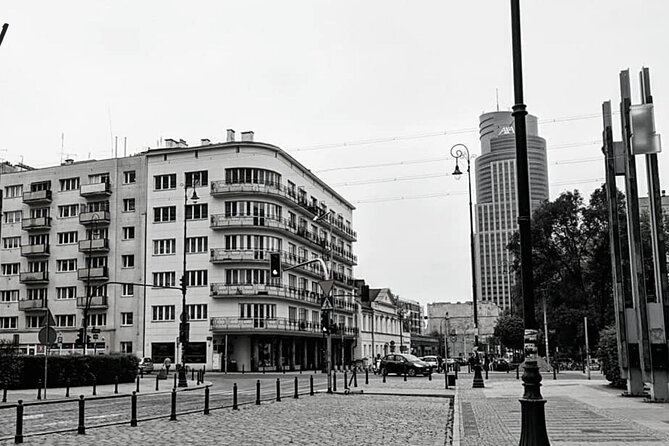
The tour starts at All Saints Church Warsaw, Pl. Grzybowski 3/5, at 10:00 am, and ends at POLIN Museum, Mordechaja Anielewicza 6. The group can run up to 40 people, and you’ll be with a local guide plus a professional guide. I like this setup because it usually means you get both on-the-ground context and a guided narrative that stays anchored to the specific streets you are standing on.
You’ll also want to know the practical stuff before you dress for it. This experience runs in all weather conditions, so plan for rain and cold. You should have moderate physical fitness, because the route is mostly outdoors for the full 2.5 hours. It is near public transportation, and there is a mobile ticket, which keeps things easy on the day.
One more thing I appreciate: the meeting and ending points are set. You do not need hotel pickup, and you do not need to arrange transportation to get back to where the tour finishes. That alone saves time, especially if you are touring solo or using public transit.
More Jewish heritage walks in Warsaw:
- Warsaw: Warsaw Ghetto Private Walking Tour with Hotel Pickup
★ 4.9 · 369 reviews - Warsaw: Jewish History Guided Walking Tour in English
★ 4.7 · 324 reviews - Private Tour: Warsaw’s Jewish Heritage by Retro Fiat
★ 5.0 · 208 reviews
Grzybowski Square: one of the ghetto’s few surviving areas
The first stop is Grzybowski Square. The reason it matters is simple and powerful: it is described as one of the very few areas that survived the destruction of the Warsaw ghetto. That survival changes how you experience the square. Instead of thinking only about what is missing, you also notice what remains, and you start to understand the layers of the city.
This is a great “set your brain” moment. A guided start here helps you shift from sightseeing mode to listening mode. The guide has a chance to explain why this particular space is treated as historically significant, and why the absence of many physical remnants makes interpretation even more important.
Practical note: this stop is listed at about 20 minutes, so don’t expect a long sit-down. Bring your focus. If you arrive slightly rushed, this is the kind of start where you will still be able to catch up, but you do need to be present.
Nożyk Synagogue: the only surviving pre-war Warsaw synagogue
Next you’re headed to Nożyk Synagogue, described as the only surviving pre-war Warsaw synagogue. That single detail reshapes the emotional temperature of the tour. You are not only learning about the ghetto era and the war years, you are also looking at a religious and community space that predates the catastrophe.
The tour time here is about 30 minutes, and admission is listed as ticket-free. Still, I’d keep expectations flexible. In many walking tours, you might get exterior time and a guided explanation more than an extended interior visit. If synagogue access is limited by time, schedule, or local rules, you will still get the history tied to the building itself.
What makes this stop especially valuable is the contrast it offers. The rest of the route leans heavily toward borders and memorials, while the synagogue points to what was there before the destruction. Guides who are strong at answering questions tend to do well here, and the tour’s guides are repeatedly described as open and engaged, like Olivia and Andrew, who were praised for fluent English and clear, vivid detail.
Waliców and Chłodna Street: tracing the ghetto border and the missing footbridge
After Nożyk Synagogue, the tour moves to Waliców, described as once the ghetto border. Then you’ll go to Chłodna Street, where there is a monument commemorating the footbridge that once connected parts of the Warsaw ghetto.
These two stops work as a pair because they help you picture something that is hard to visualize from a map. A walking route turns geography into understanding. You can stand where a boundary once ran, then look at a memorial that signals a connection that no longer exists. That footbridge monument in particular is a memorable anchor, since it highlights movement and separation at the same time.
Time-wise, you’ve got about 30 minutes at Waliców and about 20 minutes at Chłodna Street. In a shorter visit, the guide needs to be efficient, and that is where strong guiding shines. Several guides are described as knowledgeable and question-friendly, which matters here. When you see borders and connections reduced to street-level markers, you’ll want your guide to clarify what you are looking at and what it meant in everyday terms.
One drawback to be aware of: the route is outdoors. If it is cold, this is not the tour where you can pretend weather doesn’t matter. You will want gloves, something windproof, and shoes with decent grip.
More walking tours in Warsaw:
- Warsaw: Old Town Highlights Walking Tour in English
★ 4.7 · 1,516 reviews - Warsaw: Old Town Guided Walking Tour
★ 4.9 · 599 reviews - Half-Day Polish Food Walking Tour with Guide and Dinner
★ 4.5 · 381 reviews - Old Town Warsaw Walking Tour
★ 4.5 · 333 reviews
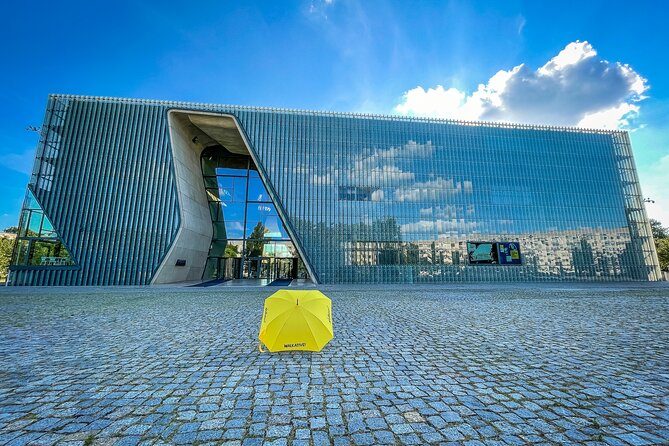
POLIN Museum in 20 minutes: what you can get from the museum stop
The tour’s biggest “anchor moment” inside a cultural space is the POLIN Museum of the History of Polish Jews stop. This is listed at about 20 minutes, and it also includes reference to the 1948 Monument to the Ghetto Heroes.
I like this decision, even with the short time. In a 2.5-hour tour, you cannot do a full museum day. But you can use a museum stop strategically: you show up at the museum, you focus on the part of the story tied to the ghetto, and you get a guided context that helps you decide what to explore later on your own.
Because you only get a slice of time, I recommend having a quick plan before the tour starts. If you want, pick one theme you care about most, then use the guide’s explanation to point you toward where to spend extra time after the walk ends.
Also, admission is listed as ticket-free at this stop. That makes the POLIN visit feel like a bonus rather than a paywall, which improves the value. And since the tour ends here, you can decide on the spot whether to keep exploring the museum after your guided walk is done.
Monument to the Heroes of Warsaw: a pause that changes how you feel
The last major stop before finishing is the Monument to the Heroes of Warsaw, with about 30 minutes on the schedule. This is where the tour shifts toward remembrance. A monument like this is not meant to be rushed, and the extra time signals that the guide wants you to slow down mentally.
This portion is often the hardest, but it is also the most meaningful. The tour’s tone is described as powerful and sad, and the guides are praised for building the story with accuracy and care, even when there is not much physical remains to point at. When you reach a memorial space, you stop trying to infer and you start absorbing.
If you are sensitive to heavy topics, give yourself permission to take breaks. The pace is not built like a fast photo walk, but it is still a street tour. If you need to step aside briefly, do it. You’ll likely find that most guides are patient and will wait while you gather yourself.
Guides who explain clearly, and a humor level that helps
One of the standout themes in how people describe the experience is the guide style. Named guides like Olivia, Jacek, Andrew, and Tomas come up as strong examples of clear explanations, fluent English, and the ability to handle questions without getting defensive.
You’ll also notice that humor shows up, but it is not the kind that trivializes. Instead, it’s described as dry, or as a way to keep the group moving and thinking. I take that seriously. When you are learning about destruction, loss, and surviving communities, humor can be a pressure valve that makes it possible to keep listening.
Just know the guide will make the group’s tipping expectations clear. This is a pay-what-you-want style approach, explained as follows: the amount you pay covers the reservation fee and the guide’s payment, and you can reward the guide separately if you want to join the spirit of pay what you wish. In practice, guides tend to solicit tips early. Plan for it so it does not feel awkward in the middle of a serious tour.
Price and value: why $26.59 can still feel like a bargain
At $26.59 per person, this tour is priced in the midrange for a guided experience, but the value comes from how much you get packed into 2.5 hours.
First, you get a local guide plus a professional guide. That matters more than it sounds, because you’re not only learning facts. You’re learning how to read a city shaped by absence.
Second, the itinerary lists ticket-free admission at every major stop, including the synagogue area and the POLIN museum stop. Even if you do not spend money on entrances, the time you save adds up.
Finally, you’re paying for guided context at places where the physical evidence is limited. A walking tour like this is not about ticking off landmarks. It is about learning how to interpret what survives, what’s missing, and what memorials are trying to do to your memory.
One note for your budget mindset: because it is pay-what-you-want style, the total you hand over might be more than the base price if you choose to tip extra. If you like that model, great. If you prefer fixed pricing, you’ll need to decide upfront what feels fair for your group and your guide.
What to expect on the ground: walking time, sitting chances, and the pace
The tour is built around standing outdoors, moving between stops, and listening at each location. That means your experience depends on weather and your stamina. It is listed for moderate physical fitness, and the outdoor portion is long enough that cold and wind can become an issue.
One practical detail that comes through in how people describe the day: near the end, guides sometimes find a chance to sit or slow down briefly, which helps a lot if you’re tired. But do not count on a permanent break schedule. Dress for comfort, and treat this as a walking day, not a quick stroll.
If you are traveling with children, you need an adult with them, since children must be accompanied by an adult. If your group includes people who need more mobility support, I’d think about whether you can manage an outdoor history route for about 2.5 hours.
Who should book this Jewish Warsaw walking tour?
This tour is a strong fit if you want a guided street-level understanding of Jewish Warsaw, focused on surviving sites, ghetto-era geography, and the memorial spaces where the story is meant to be heard.
I think it is especially good for:
- First-time visitors who want orientation fast and a focused narrative
- Travelers who learn best from explanations at the exact places where events are referenced
- People who value accuracy and question time, not just photos
- Anyone who appreciates guides who bring a measured sense of humor to heavy material
It may not be the best fit if:
- You need lots of time inside buildings. The route includes stops with free admission, but the museum time is short.
- You dislike weather-dependent outdoor walking. It runs all weather, and the day can feel long if it is miserable outside.
- You want a very light, entertainment-heavy tour. The tone is serious, and the memorial stops are part of the point.
Should You Book This Jewish Warsaw Walking Tour?
Book it if you want to understand Warsaw beyond headlines, using a guided route that points to what survived and what is commemorated. The combination of free entry, a structured 2.5-hour flow, and guides praised by name for clarity and fluency makes it a good value, especially for a first visit.
I’d skip or rethink it only if your ideal day is mostly indoor time, or if you can’t manage cold, wind, and standing for the duration. Otherwise, this is exactly the kind of tour where you leave with a better mental map, not just a few photos.
FAQ
What is the duration of the Jewish Warsaw Walking Tour?
It runs for about 2 hours 30 minutes.
What time does the tour start, and where does it end?
It starts at 10:00 am. It begins at All Saints Church Warsaw, Pl. Grzybowski 3/5, and ends at POLIN Museum, Mordechaja Anielewicza 6.
Is the tour offered in English?
Yes, it is offered in English.
How much does the tour cost?
The price is $26.59 per person.
What is included in the price?
Included are pickup and drop-off from designated meeting points, a local guide, and a professional guide.
Is there an admission cost at the stops?
Admission is listed as free for the stops on the route, including Grzybowski Square, Nożyk Synagogue, POLIN Museum, and the memorial stops.
Do I need hotel pickup?
No. Hotel pickup and drop-off are not included, but pickup and drop-off are provided from designated meeting points.
What should I know about fitness and weather?
You should have moderate physical fitness. The tour operates in all weather conditions, so dress appropriately.
Can I cancel if plans change?
Yes. Free cancellation is available. You can cancel up to 24 hours in advance for a full refund.
Recently added in Warsaw
- Warsaw: Wolf’s Lair & Swieta Lipka Small-Group Tour + Lunch★ 5.0 · 3 reviews
- World War II Warsaw Old Town, Military Cemetery Walking Tour★ 4.7 · 3 reviews
- Warsaw Wolf’s Lair with St. Lipka and Mamerki Private Guided★ 4.2 · 3 reviews
- Warsaw Zoo Skip-the-Line Entry Ticket with Private Transport★ 4.8 · 3 reviews
- Wilanów Palace: 2-Hour Guided Tour with Entrance Tickets★ 4.8 · 8 reviews
- Warsaw: Vodka Tour★ 4.4 · 18 reviews
- Warsaw Uprising and WWII Old Town Walking Tour with Museum★ 4.7 · 15 reviews
- Warsaw: Private Vodka Tasting Night with Snacks and Pickup★ 5.0 · 7 reviews
Other Warsaw Ghetto & Jewish Heritage Tours
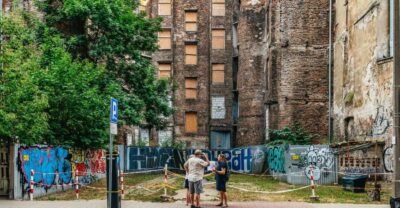
Warsaw Ghetto Private Walking Tour with Hotel Pickup
Read our review →
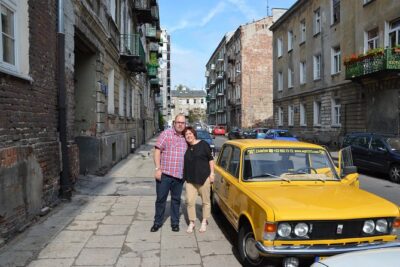
Private Tour: Warsaw’s Jewish Heritage by Retro Fiat
Read our review →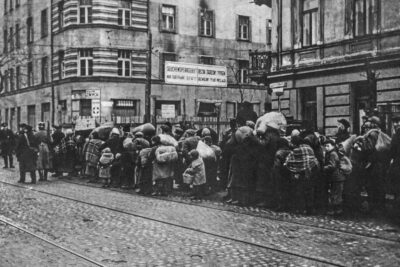
Ghetto, Jewish Cemetery & POLIN Museum Private Tour
Read our review →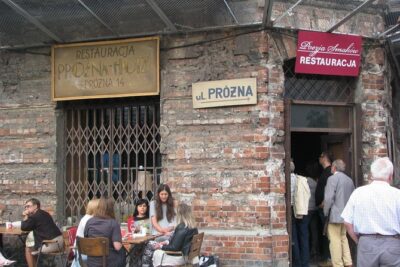
Browse the lists this tour appears in